
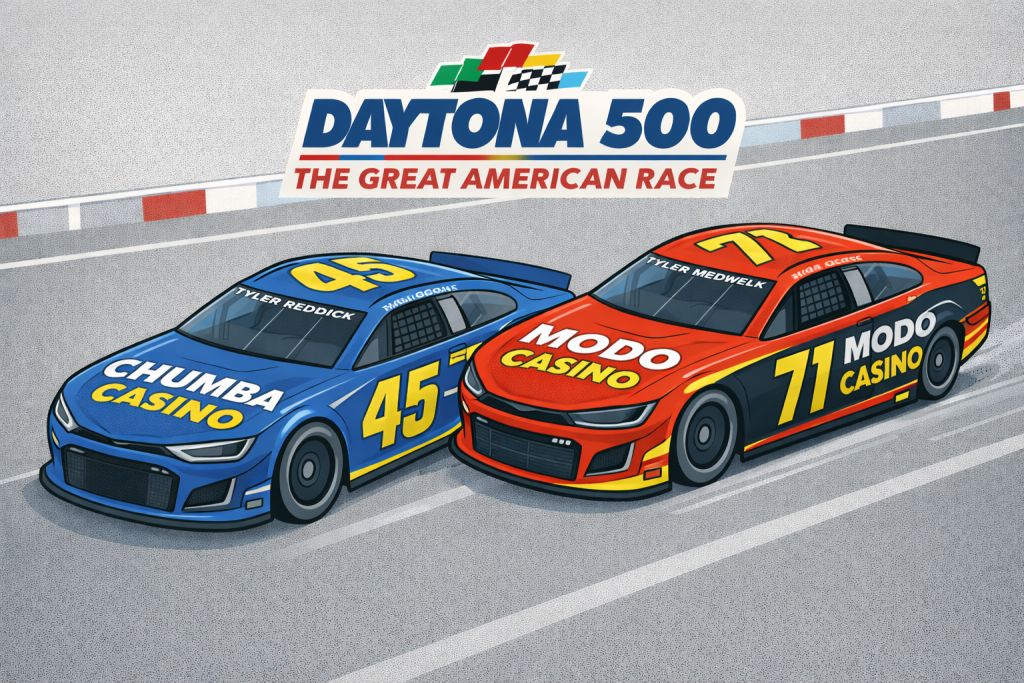
Some of the leading US sweepstakes operators—Chumba Casino (VGW) and Modo Casino (ARB Interactive)—have expanded their presence in the NASCAR Cup Series through sponsorship agreements.
Learn why at this year’s Daytona 500 (“Great American Race”) the roar of the engines was accompanied by a new kind of branding on the track—the featured high-profile sponsorships from sweepstakes casinos.
The Atypical Scenario
While traditional sportsbooks like DraftKings and Fanatics have long been part of the NASCAR ecosystem, the arrival of sweepstakes platforms like Chumba and Modo is a strategic change in gaming marketing. The Daytona 500 was an event long associated with traditional sponsors and regulated sportsbooks. Chumba Casino appeared on Tyler Reddick’s No. 45 car, which he drove for 23XI Racing, while Modo Casino appeared on Michael McDowell’s No. 71 Chevrolet, which he drove for Spire Motorsports. This is a step taken by sweepstakes casino owners and partners to ensure brand legitimacy & visibility in a regulatory environment.
Why NASCAR?
The choice of NASCAR as a marketing vehicle is no accident. For sweepstakes operators, the sport offers a unique set of advantages:
Nationwide Reach in Dark Markets
Unlike licensed iGaming platforms that are restricted to a handful of states like New Jersey or Pennsylvania, sweepstakes casinos operate in a regulatory gray area that allows them to reach players in nearly every state. NASCAR’s fan base is heavily concentrated in regions where traditional online casinos remain illegal, so it is the perfect funnel for new user acquisition.
Bypassing Digital Gatekeepers
As Google and Meta tighten restrictions on social casino and sweepstakes ads, operators are being forced to find “offline” ways to build “online” traffic. A primary spot on Tyler Reddick’s or Michael McDowell’s car provides unblockable visibility to millions of viewers.
The Trust Factor
By aligning with established brands like 23XI Racing and Spire Motorsports, sweepstakes operators are attempting to shed the gray market label. High-visibility sports sponsorships signal to the consumer that these platforms are mainstream, reliable, and legal-adjacent.
The Regulatory Counter-Current
Despite the high-speed marketing, the industry is hitting significant roadblocks. There is a lot of debate surrounding the sweepstakes model’s fundamental use of two virtual currencies, one of which can be exchanged for real money.
- Illinois recently issued letters to over 60 operators, including the very brands seen at Daytona. Regulators in New York, California, and Washington have already taken steps to ban or severely restrict the dual-currency model.
- The American Gaming Association (AGA) and state regulators argue that if a virtual currency can be converted to cash, it is a gambling product, regardless of the “sweepstakes” branding. The marketing reach is massive, but the legal lifespan of the current model is uncertain.
What This Means for Casino Owners and Partners
For the Axionus community, this shift in the market offers several critical lessons on the future of gaming partnerships:
1. Traditional Casinos Should Watch the Sweepstakes Playbook
Sweepstakes operators are masters of social engagement and frictionless entry. Traditional land-based and online casinos can learn from how these brands use social gaming mechanics to build massive databases in states where real-money gaming hasn’t yet arrived. When those states eventually legalize iGaming, the sweepstakes operators will already have the largest warm lead lists in the country.
2. Ad Spend Diversification Is Required
The move into NASCAR shows that the industry is anticipating a future where digital ad space is either too expensive or entirely blocked for gaming products. Marketing teams should be looking at “physical-to-digital” sponsorships—events, podcasts, and sports teams—to build brand equity that doesn’t rely on a Google algorithm.
3. The Risk of Brand Association
For potential partners, the sweepstakes sector is a high-reward, high-risk play. While the revenue and reach are enticing, the legal volatility means that partnerships should be structured with flexibility. Any brand alignment in this space must be weighed against the potential for sudden regulatory shifts that could turn a legitimate sponsor into a legal liability overnight.
A Race Against Time
The presence of Chumba and Modo at the Daytona 500 proves that sweepstakes casinos are no longer a niche corner of the internet—they are aggressive competitors for the American gambler’s attention. However, the industry is in a race against time. As they push for mainstream acceptance through high-profile sponsorships, they are also drawing the attention of every major regulator in the country. So, observe how these brands capture the player but stay agile enough to pivot as the regulatory finish line approaches.